Updated: June 2026 | Read Time: ~8 minutes | Category: BISP / Government Aid
📋 Table of Contents
- My Neighbor's Story — Why This Guide Exists
- What 8171 Actually Is (No Jargon)
- Check Payment via SMS — Step-by-Step
- Check via BISP Web Portal
- The BISP Mobile App in 2026
- Who Is Eligible — Straight Answer
- Payment Amounts in 2026
- Mistakes I've Seen People Make
- What to Do If You're Marked Ineligible
- Wrapping It Up Honestly
My Neighbor's Story — Why This Guide Exists
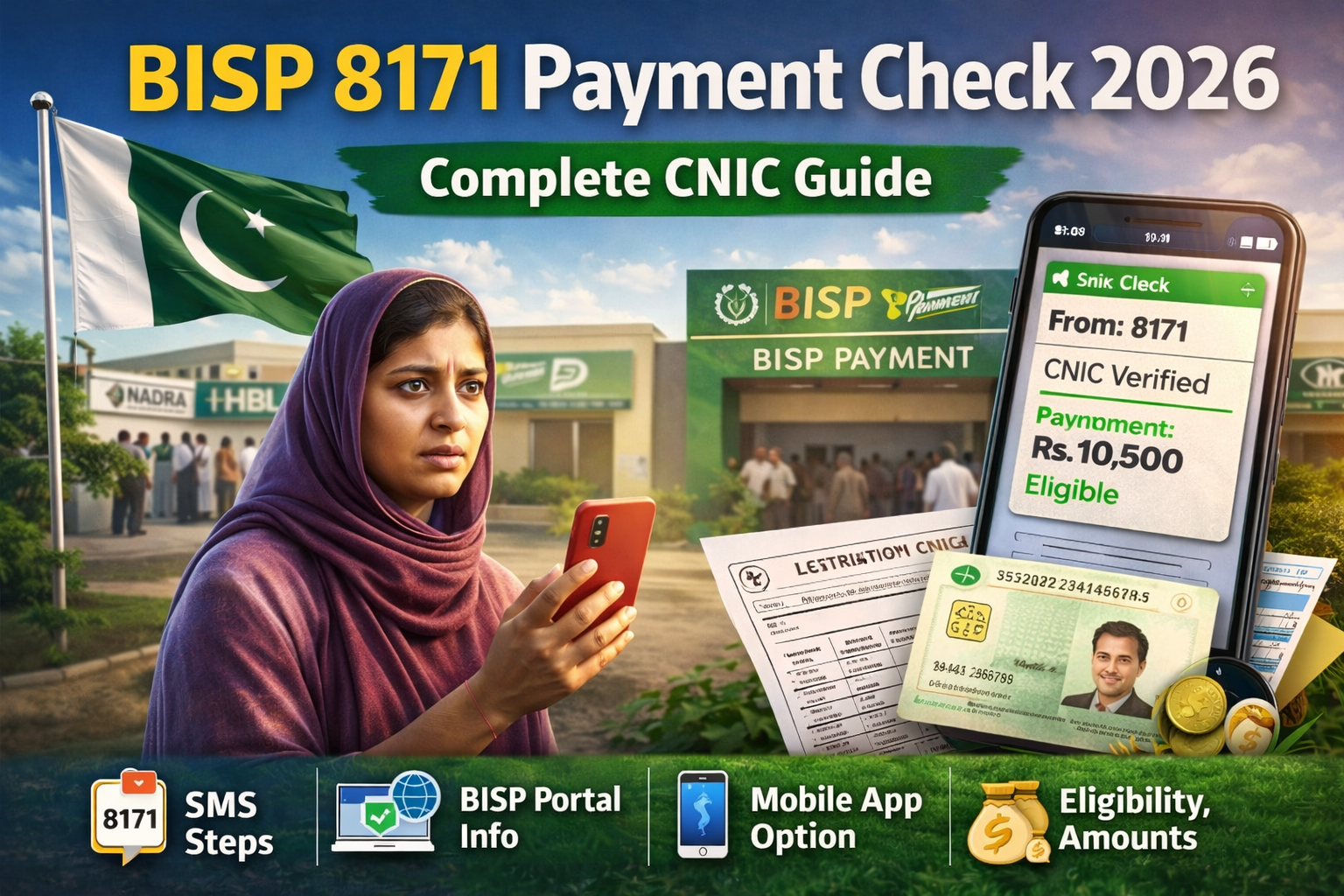
My neighbor Rubina — a widow with three kids in Lahore — had been hearing about BISP payments from other women in her mohalla for months. One of them told her she was getting Rs. 10,500 every quarter. Rubina rushed to register herself and then spent the next three months going back and forth between the BISP office and local NADRA centers, asking "kia mera payment aa gaya?" Every time, either the system was down, or the person at the desk didn't know what to do, or she was told to "wait a few days."
Sound familiar? This is the reality for thousands of families across Pakistan. The money is often there — they just don't know how to check it correctly, or they keep checking through the wrong channels.
Eventually, I sat with her, opened her phone, and showed her the exact steps. Within two minutes, she knew her status. She was registered, eligible, and her payment was literally sitting at the nearest HBL payment center waiting for her. She had no idea.
That afternoon changed how I thought about this. The problem isn't usually the program — it's the information gap. So I wrote this guide for every Rubina out there.
"The money was sitting there for three months. She just didn't know where to look."
What 8171 Actually Is (No Jargon)
Let's just be clear about this because a lot of people confuse the number with the program. 8171 is the SMS helpline code managed by the Benazir Income Support Programme (BISP). You SMS your CNIC number to this short code, and the system replies with your payment or eligibility status.
BISP itself is a federal government program that gives quarterly financial assistance to low-income families in Pakistan, especially women-headed households, widows, and families with disabled members. It operates under the National Socio-Economic Registry (NSER) — which is just a fancy name for the big survey database where your household details are stored.
The 8171 number works on every network — Jazz, Zong, Telenor, Ufone, and even SCOM. You don't need internet. You just need an active SIM and your 13-digit CNIC number.
⚠️ Quick Note: Your CNIC number must be the registered female head of household's CNIC for the SMS check to return accurate results. If you SMS your husband's CNIC but the registration is under the wife's name, you'll often get confusing results.
Check Payment via SMS — Step-by-Step
This is the easiest method and works without internet. I recommend this first for anyone in a rural area or with a basic phone.
Step 1 — Open your SMS / Messages app
This works on any mobile phone — Android, keypad, or even an old Nokia. You don't need a smartphone.
Step 2 — Type your 13-digit CNIC number
Write it exactly as it appears on your ID card — no dashes, no spaces. Just the 13 digits back to back. Example: 3520212345678
Step 3 — Send it to 8171
Type 8171 in the "To" field and press send. SMS charges may apply (usually Rs. 1–2 depending on your network).
Step 4 — Wait for the reply SMS
It usually comes back within 30–90 seconds. If it takes longer than 5 minutes, your network may be congested — try again later, especially avoid sending during peak hours like 12–2 PM.
Step 5 — Read the response carefully
The reply will say either that you are eligible and mention the payment quarter, or it will say you are not registered / not eligible. Note down the exact message for future reference.
📱 SMS Format:
Send To: 8171
Message: Your 13-digit CNIC number (example: 3520212345678 — no dashes, no spaces)
⚠️ Watch Out: If you receive a reply saying "CNIC format incorrect" — it means you included dashes or spaces. Retype it as pure digits. Also make sure you're using the registered CNIC — not a relative's.
Check via BISP Web Portal
If you have internet access, the BISP online portal is more detailed than the SMS reply. It shows your registration status, payment history by quarter, and even the nearest payment point.
Step 1 — Open your browser
Chrome, Firefox, or even the built-in Samsung browser works fine. Go to the official BISP website: bisp.gov.pk
Step 2 — Find the "Payment Inquiry" section
On the homepage, look for a button or link labeled "Payment Inquiry" or "Check Eligibility." It's usually prominently placed — BISP has redesigned the portal a few times, so scroll if you don't see it immediately.
Step 3 — Enter your CNIC
Type the 13-digit number in the field provided. Sometimes the portal auto-formats it with dashes — that's fine, let it do that.
Step 4 — Complete the CAPTCHA and Submit
There's usually a small CAPTCHA (those blurry letter/number boxes) to prove you're human. Fill it in and click submit.
Step 5 — Review your payment details
The results page will show: registration status, current eligibility, last payment date, amount, and the nearest disbursement point (HBL, Finca, or agent location).
✅ Pro Tip: Take a screenshot of the result page. If there's ever a dispute at the payment center, having that screenshot on your phone saves a lot of back-and-forth.
The BISP Mobile App in 2026
BISP released an updated mobile app — available on the Google Play Store — that bundles the payment check, nearby agent finder, and complaint submission into one place. I've tested it and honestly, it's improved a lot since the clunky early version.
The app is called "BISP" or sometimes listed as "Benazir Income Support Programme" on the Play Store. Search for it carefully — there are copycat apps with similar names that are NOT official and could be a security risk. Always verify the developer is listed as Government of Pakistan or BISP Pakistan before installing.
One thing I noticed: the app is primarily in Urdu, which is actually great for accessibility. But the input field for CNIC can sometimes lag on low-RAM phones. If the app freezes, just restart it — it's not your data, it's just the phone struggling.
🚨 Safety Warning: Never install BISP apps from WhatsApp links or third-party websites. Scammers have created fake apps that steal personal data. Only use the Google Play Store or Apple App Store, and double-check the publisher's name before downloading.
Who Is Eligible — Straight Answer
This section trips people up the most. Let me be direct about who qualifies, based on the current NSER data and BISP guidelines for 2026.
| Criteria | What It Means | Status |
|---|---|---|
| PMT Score | Proxy Means Test score — calculated from your NSER survey data. Lower score = poorer household = eligible. | Must be below cutoff (varies by region) |
| Female Head of Household | Registration is generally in the name of the woman of the house | Required for most BISP programs |
| Valid CNIC | CNIC must not be expired. Check your expiry date on the card. | Mandatory |
| NSER Registration | Your household must have been surveyed under the NSER door-to-door survey | Mandatory |
| No Government Job | Active government employees' households are generally excluded | Disqualifying factor |
| No Land/Assets Above Threshold | Owning agricultural land above a certain acreage or a registered vehicle may disqualify | Checked via database |
A common misconception is that you need to be living in poverty to "look a certain way." The PMT score is calculated from data — NADRA records, land records, vehicle ownership, and your NSER survey responses. The survey questions themselves carry significant weight. This is why it's crucial to have filled out your NSER survey accurately.
Payment Amounts in 2026
BISP runs several sub-programs, and the payment you receive depends on which one you're enrolled in. Here's a simplified breakdown for 2026:
| Program | Amount (Quarterly) | Target Group |
|---|---|---|
| Benazir Kafalat (Core Program) | Rs. 10,500 – Rs. 13,500 | Eligible low-income families |
| Benazir Taleemi Wazaif | Rs. 2,000 – Rs. 3,500 per child | Children in school (primary to secondary) |
| Benazir Nashonuma | Rs. 2,000 per month | Pregnant women, children under 2 |
Note: Exact amounts can vary based on government budget revisions. These figures reflect the latest publicly announced rates as of early 2026. Always check the official BISP portal or your SMS response for the confirmed amount for your specific household.
✅ Good to Know: If your child is enrolled in school and you're already a Kafalat beneficiary, make sure your child's enrollment is registered with BISP. Many families leave Taleemi Wazaif money on the table simply because they never completed that sub-registration step.
Mistakes I've Seen People Make (Please Don't)
After helping a handful of people in my community with this process, I've seen the same mistakes repeated over and over. These aren't stupid mistakes — they're just information gaps. Here's what to watch for:
❌ Mistake 1 — Using a Male CNIC for the SMS Check
Most BISP registrations are under the woman's CNIC. If you SMS your husband's CNIC and the registration is under your wife's name, the system will say "not registered." Use the correct CNIC.
❌ Mistake 2 — Checking from an Expired CNIC Number
If your CNIC expired and you got a new card (with possibly a new chip but same number), the number is usually the same — but double-check. If you renewed and your CNIC was updated in NADRA's system, the old number may not return correct results.
❌ Mistake 3 — Trusting Middlemen Who Charge Fees
I've personally seen people in my area pay Rs. 200–500 to "agents" who just do the SMS check on their behalf. The SMS costs Rs. 2. Do it yourself.
❌ Mistake 4 — Not Collecting Payment on Time
Payment windows at agents and HBL branches are time-limited. If you wait too long after the payment is released, there can be complications with collection. Check your status soon after each quarter begins.
❌ Mistake 5 — Assuming "Ineligible" Is Permanent
Eligibility can change. If your household circumstances changed (lost a breadwinner, became a widow, etc.), you can apply for a re-survey or grievance redressal. Don't just accept one "no" as final.
❌ Mistake 6 — Ignoring the NSER Survey When It Comes to Your Door
Some families refused the survey team out of suspicion. That survey is the foundation of your eligibility. If you missed it, you can request a survey at your nearest BISP tehsil office.
What to Do If You're Marked Ineligible
Getting an "ineligible" reply stings, especially if you genuinely need the support. But don't panic. There are legitimate steps you can take.
Step 1 — Verify Your NSER Data
Go to your nearest BISP tehsil office and ask to see your household's NSER data. Sometimes survey data was entered incorrectly — a wrong house address, an overstated income figure, or an asset that was misrecorded. You have the right to see and challenge this data.
Step 2 — File a Grievance
BISP has a formal grievance redressal mechanism. You can submit a complaint at the tehsil office, or through the BISP app/portal. Keep a copy of your complaint reference number — always.
Step 3 — Request a Re-Survey
If your circumstances have genuinely changed since the original NSER survey (death in family, divorce, disability, job loss), you can request a fresh household survey. Bring supporting documents — death certificate, disability certificate, or whatever is relevant to your situation.
Step 4 — Contact the BISP Helpline
The BISP helpline number is 0800-26477 (toll-free). It's not always easy to get through, but calling in the early morning — around 9 to 10 AM on weekdays — tends to have shorter wait times based on my experience.
✅ Real Tip: When visiting the BISP tehsil office, bring your original CNIC, a copy, your NSER survey slip (if you have it), and any documents supporting your case. Going prepared means fewer repeat trips — and trust me, repeat trips to government offices are draining.
Wrapping It Up Honestly
Look, BISP is an imperfect system operating at a massive scale — millions of families across Pakistan. The helpline gets jammed, the portal sometimes goes down, and field offices can be chaotic. All of that is real.
But underneath all that friction, the program does release payments. Money does get disbursed. And most of the time, when someone tells me "mujhe payment nahi mili," the actual problem turns out to be one of three things: wrong CNIC used, payment was ready but nobody collected it, or the person didn't know where their nearest payment agent was.
The 8171 SMS check is the fastest tool in your pocket. Use it. Check it at the start of each quarter (January, April, July, October). Screenshot your result. And if something seems wrong, don't just accept it — go to the office and ask questions. You're entitled to that.
Rubina, by the way, has been collecting her quarterly payments without issue ever since. She now helps other women in her building understand the same steps. That chain of helping — that's what this guide is meant to fuel.
If this helped you, share it with someone in your family or community who might need it. The information is free. The help is real.
Written by a Pakistani Tech Blogger — Based in Lahore. I write about government digital services, mobile tools, and practical guides for everyday Pakistanis.
📌 Disclaimer: This article is for informational purposes only. BISP policies and payment amounts can change. Always cross-check with the official BISP website (bisp.gov.pk) or call the toll-free helpline 0800-26477 for the most current information. This guide does not represent any government body.